Showing posts with label posts by Agne. Show all posts

Sunday, 1 December 2013

Lithuania's fans, we have now got a dedicated bookshelf for you


Opening the new Lithuanian literature section. Left to right: Lithuanian charge d'affaires for Bulgaria Darius Gaidys, Sofia City Library's deputy director Spaska Tarandova, EVS volunteer Agne Drumelyte. 

Sofia City Library is known for its international and otherwise eclectic character. Downstairs we have a bar, on the first floor a gallery and a theatre, and on the fourth floor there are multiple reading resources in foreign languages.

So far on the fourth floor there have been books in English, Portuguese, Chinese, Turkish, Spanish & Latin American, German, and in four Scandinavian languages, most of them donated by the respective countries' embassies and cultural institutions.

Although I am officially a UK volunteer and do my best to represent the sending country, I am also a Lithuanian. Since there already were many books at the library donated by the UK, I decided to have a look if there would be any resources from/about Lithuania.

Surprise surprise, with the help of my tutor I found only several dry-ish (and, often, dated) information materials. Looking at the aforementioned countries' example, I thought, it would be nice to have a dedicated Lithuanian book shelf at the library too. I set up (besides the shared EVS blog and my free time Bulgarian travel etudes) a third personal project. 

An email and then a trip to the Lithuanian Embassy in Sofia followed; I was invited to meet the Lithuanian Charge d'Affaires Darius Gaidys. The Embassy took the matter enthusiastically. Soon afterwards Mr Gaidys came to visit the library and to meet the deputy director Spaska Tarandova.

After arranging the place for the new book shelf and the opening date, the donation of books & CDs from the Embassy and from a few people of the local Lithuanian community was brought in. Then the official opening event happened, with speeches from Mr Gaidys and Ms Tarandova, and a small wine reception.

The books will now have to be registered at the library's catallogues. They should be available for everyone to borrow from 15 January 2014.

The new book shelf is at the Nordic & German reading room (402) on the fourth floor. The present reading resources are in Lithuanian, English, Bulgarian, Russian. There are quite a few books for children & beginners in Lithuanian language. The collection is likely to expand in the future.            

The Embassy and the Library have plans to continue the recently set up collaboration.

In the nearest future, at 5 pm on 11 December at the American Corner there is going to be a presentation of a new book, the Bulgarian translation of Lithuanian classic poems by Justinas Marcinkevičius ('Mindaugas', 'Mažvydas', 'Katedra').

In the second half of 2013 Lithuania held Presidency of the Council of the EU.

The new book shelf. In the future I would love to see there also English/Bulgarian translations of 'Vilnius Poker' by Ričardas Gavelis and of novels by Jurga Ivanauskaitė & Kristina Sabaliauskaitė; 'The Jungle' by Upton Sinclair; 'Lost Vilnius' by Vladas Drėma; 'Forest of Gods' by Balys Sruoga; works by the Lithuanian-American anthropologist Marija Gimbutas; arts albums & music recordings by Mikalojus Konstantinas Čiurlionis; photography album 'Unseen Lithuania' by Marius Jovaiša; materials about Lithuanian artists such as Fluxus persona Jurgis Mačiūnas, filmmaker Jonas Mekas, designer Juozas Statkevičius; film 'The Other Dream Team'; Lithuanian jazz music recordings; more history books & memoirs, especially about/from the 20th century /.../ To mention a few.      

Opening, wine reception.
Opening, having a look at the new book shelf.

The immortal Christmas poster from USA. Our former sister library


Season's greetings from Golden branch of the Jefferson County Public Library, USA.

Christmas is mercilessly approaching. People put up festive decorations; Here at Sofia City Library we have got a permanent one. It has been given to us by Golden Public Library, USA, and it has been hanging above the door of the English & Portuguese reading room for several years now.

How come we have got a festive decoration from a library in Colorado, one that is almost 10.000 kilometres away from ours? Not a bad question.

Apparently, the said friendly library and our library had been 'sisters' for some years in the past. They used to exchange books, invite each other's staff over for visits, conferences and trainings, send each other Christmas greetings like the one pictured above.

It all started when, back in 1995, a Bulgarian librarian Iskra Mahailova went to the USA for five months to work at the Colorado State Library. There she met Nancy Bolt (pictured below) who turned out to be a Bulgaria enthusiast.  

Nancy Bolt, the initiator of the American-Bulgarian partnership. She remembers, in the early days of the friendship the Americans used to send video greetings to their Bulgarian colleagues as back then were still the pre-Skype times. Photo (c) Nancy Bolt.
Over the next few years Ms Bolt made repeated trips to Bulgaria: to visit her former colleague, to do a lecture tour, to take part in conferences. Partnerships were formed between various Bulgarian and Colorado libraries - one between Sofia City Library and Jefferson County Library was among the first.

Later a grant from the USA government was received for the ABLE (American-Bulgarian Library Exchange) project. Eighteen partnerships between American and Bulgarian libraries were covered; Bulgarian and American librarians were enabled to visit each others' countries.

''We also did training for 14 Bulgarian librarians on how to become a community information center and these librarians trained anther about 900 librarians'', Ms Bolt says.

The grant in the end was discontinued; some of the partnerships fell apart. Sofia City Library & Golden Library stopped their official sisterhood several years ago. However, some of the librarians have been keeping in touch and meeting informally.

Ms Bolt still goes to Bulgaria every year, usually in May so that she can attend the Rose Festival in Kazanlak. She participates in conferences in Bulgaria, gives trainings, stays in touch with some of Sofia City Library's staff, and is about to publish a paper at the BLIA* magazine on the changing role of the library.  

The Colorado librarians were pleased to know that Sofia City Library still has the poster.

* Bulgarian Library and Information Association.

Chestita Koleda.

Monday, 4 November 2013

Hristo Botev and his 20 poems

Bulgarian poet and revolutionary Hristo Botev (1848-1876), approximately one year before his death. Image (c) Wikimedia Commons.

Now, what to write about this poet? His authority in literature - and history - is almost universally unquestioned by the Bulgarians. He is the subject of many studies, books and artworks. He has been so scrutinised that I would probably be unable to say anything exhaustive or new about him.

The person in question is the legendary Hristo Botev. He died when he was 28 years old, leaving behind only 20 poems, plus some opinion pieces and letters - but the short, intense lifespan and the strength of his writings were enough to prove that he was exceptional in Bulgaria, both as a poet and as a political leader.

Today perhaps every Bulgarian city and town has a street named after Botev (along with those named after Vasil Levski, Stefan Karadzha and other revolutionaries). At noon on 2 June every year everything stops and loud sirens commemorate for about a minute the death of Botev back in 1876, during the fight against the Ottomans in Vratsa mountains. He is that important.

As a 19th century author, Botev is a romanticist. His poems are dramatic, expressive, visual, philosophical - all at the same time. Popular topics include homeland; death; a beloved girl; mother, father & other members of the family; freedom fighters (e.g. there are two poems about the death of Vasil Levski and Hadzhi Dimitar); patriotism; solidarity; the struggle for independence. A couple of poems (Patriot and In The Tavern) are sarcastic, questioning the morals of certain people.        

Many Bulgarians will volunteer to inform you that a verse by Botev is engraved in gold at the Sorbonne in Paris among other verses by the world's greatest poets:

“The moon comes out and day grows dim, 
on heaven’s vault the stars now throng,
the forest rustles, quiet stirs the wind,
the mountains sing song of fighters.”


(from Hadzhi Dimitar, 1873)

It should not take you more than half of a day to get acquainted with Botev's poems. If you are at least a little interested in Bulgaria & its history, reading them is a must. You can easily find the texts of all 20 poems on the internet, for example, here

Saturday, 2 November 2013

A thoughtful Halloween afterparty: the Bulgarian Day of the Enlighteners

1 November at Sofia City Library: discussing the Bulgarian history, reading from old, original books.

When much of the Western world are recovering from Halloween festivities the night before, on 1 November Bulgarians commemorate their Day of the Enlighteners.

The day - perhaps symbolically set during the darker, gloomier time of the year - is dedicated to writers, educators, national revivalists, revolutionaries, freedom fighters.

The celebrated heroes include many historical figures, such as the Brothers Cyril and Methodius, the national poet Hristo Botev, the 'Apostle of Freedom' Vasil Levski. Influential books, both factual and literary, are remembered; important events of the Bulgarian history re-discussed; poems and excerpts of well known texts read aloud.

The celebration of the Day of the Enlighteners started in 1909, one year after Bulgaria declared its independence from the Ottoman 'yoke', but the Day did not become particularly popular up until the 1920s. During the communist times (between 1945-1992) celebrations of 1 November were banned altogether.

Nowadays 1 November is listed in the calendar of Bulgarian Official Holidays and is celebrated in places like educational institutions, libraries, museums all over the country. It is also the day of Bulgaria's patron saint, Ivan (John) of Rila.

'Istorya Slavobolgarskaya' (1924 edition) - the first Bulgarian history. Written during the Ottoman times (1762), this was the book that fueled nationalist feelings and motivated many Bulgarian freedom fighters.

'Osmoglasnik', or 'Eight Voices' (1645) - the first Bulgarian printed book. Note the two, black and red, colours, and the detailed decorative ornaments. From next April (2014) the book should be on display at the new Sofia City Museum (due to open inside the yellow former Central Mineral Baths building).  
A page from 'Nedelnik' (1806), the first published book in modern Bulgarian. There are only six known original 'Nedelniks' left in Bulgaria today; two of them can be found at Sofia City Library.  

Monday, 28 October 2013

Getting to know Sofia, the host city of your EVS

Largo, Sofia, Bulgaria. Why two buildings from different historic periods [1920s, the bourgeois era, and 1950s, the socialism] and of different architectural styles were fused into one? You can find out on a 'Sofia (Architecture) Walks' tour...
  
An important part of the EVS experience is getting to know the host country. Many Bulgarians are patriotic and will spend long hours informing you about their homeland. They have reason: Bulgaria is very old and has an interesting history.   

So does their capital. Although to an inexperienced eye it might appear as yet another character-less modern age city, Sofia actually existed even before the ancient Romans arrived. A big misfortune was brought to Sofia by the WW2 when much of the city centre was destroyed by the bombings. Those were also the times when Sofia lost much of its external beauty.  

Nowadays it is one of those cities that not everyone falls in love with easily. Before you start to like Sofia you need to know it. And, in order to know it, you need to explore and dig a bit deeper as the city hides much of its charms in secret yards; underground; in peoples' memories.
  
Because Bulgarians are so patriotic, there is no shortage neither of tourist materials nor of guided walks here (as well as plenty of cultural events to choose from). Let me introduce you to a few:
  • Free Sofia Tour (also operating in Plovdiv) is a good option to those who have just arrived as it gives a nice overall introduction to the city centre's major (and major hidden) attractions. It lasts around two hours, leaving at 11am & 6pm every single day from the Palace of Justice (the building with two lion sculptures at the northern end of the Vitosha Boulevard). The tour is unpaid but it is customary to give some tips to the guide afterwards.     
  • Sofia (Architecture) Walks - a bit heavier option, ideal to those who are already familiar with the surface of the city and want to dig deeper. These guides organise their walks mainly on weekends, and each walk has a different topic, e.g. Socialist Sofia; Romantic Sofia; Eastern Orthodox Sofia; Sofia Cemetery; etc. The tours are grouped into four 'collections': Pieces of a City, Styles and Ages, Religions, and Influences - according to the topic. Each month they announce a walks' calendar on their website so you can book in advance. These are paid tours (BGN 20/10 adult/student); the meeting place is at the entrance of Sheraton Balkan Hotel.
Then there are a couple of recommendable travel agencies (these, though, are not the only ones in Sofia):
  • Lyuba Tours - a small, rather high-brow travel agency that concentrates on cultural tourism and knows a lot about even obscure topics. These were the people who took many famous and serious foreign officials around Bulgaria. They do some public group tours (advertised on their website) as well as tailor-made private tours.
  • Zig Zag Holidays / Odysseia-In 'travel boutique' - also a personalised, responsible, knowledgeable etc. travel company. As far as I know they were consulting one of the Lonely Planet travel authors as he wrote the guide to Bulgaria some years ago. Plus, they have been on the market for around 20 years now.
True, hiring travel agencies might not exactly be for a volunteer's budget but it's good to know where to go in case, for example, your rich relatives arrive to Bulgaria, or you are organising an event for international delegates.

Some 'real' travellers are snobbish towards any travel publishers, guides or agencies; I used to be one of them but I am not anymore; now I think that selecting bits of what you find useful/interesting from all available sources is the best way to be.  
  • If you, however, only want a free map of the city you can get one at the local Tourist Information Office at the underpass + metro station 'St.Kliment Ohridski' (the Sofia University).
Good luck exploring. You can also check my personal blog about life & travels in Sofia. Yours, Agnė.

The sausages are not mine. Associative photo.
Some of the current EVS volunteers at Matka Canyon, Macedonia (July 2013).

Tuesday, 1 October 2013

Dora's organic garden - a few principles

An autumn sunflower field I found while hitch-hiking in Northern Bulgaria. Associative photo.

Following the recently discussed topic of sustainable agricultural practices, we might as well talk about organic gardening. Permaculture itself is not necessarily organic but the two go well together.

Our fellow EVS Dora from Vlahi (mentioned in the previous post) cultivates an organic garden as part of her project and has shared with us a few tricks of how to be most efficient and to naturally avoid pesticides, herbicides and other similar evils. To me, some of them have been a nice discovery and, I thought, why not to forward them on to you too, our dear dedicated reader   

(1) The Three Sisters of pre-Colombian American agriculture, starring corn, pumpkin and beans. According to Native American wisdom, the three plants help each other to grow and to feed. They have a symbiotic relationship. For example, the bean plant grows wrapping itself around corn, and the two exchange bacteria that keeps pests away. 

(2) Planting companion plants, such as onion & carrot; tomato & basil; aubergine & beans, together. They keep harmful insects away from each other, and therefore, the gardener does not need to use pesticides.

(3) Taking advantage of friendly garden animals. Apart from singing nicely, birds eat many harmful insects and produce manure which is a natural fertiliser. To attract certain birds to your garden you may need to plant certain bushes, e.g. raspberry or goji berry for sparrows & tits. Grasshoppers eat insects, and so do bats - the latter during the night, so your garden may be protected 24/7.

Wasps also eat insects - build a place for them to live in your garden. Ladybirds feed on plant lice - they like to settle on nettle and yellow flower, so make sure you have some of the said plants present to attract ladybirds to your garden.    

Yellow multipeds feast on slug eggs. Ducks eat insects and slugs, and produce manure - make a pond for them in your garden (in the pond, grow some gambusia fish - they will eat the mosquito larvae). Chickens do similar deeds to those done by ducks.

Hedgehogs, besides generally being sweet and charming animals, will cut down the numbers of slugs, caterpillars, multipeds and chockhafers. Snakes will eat mice; lizards will eat insects; and toads love to snack on Colorado beatle (toads, like ducks, will need access to a pond in your garden). Frogs will feast on insects and slugs.     

(4) You might want to plant your herbs in reinforced spirals. The said constructions help the gardener to use water efficiently. Higher in the spiral should be plants that need less water; those needing more should sit a little below. On the south side put plants that like sunlight; on the north side put those that thrive well in the shadow. Spiral works well for growing herbs, medicinal ones and kitchen ones alike.

(5) Finally, put up a tank for collecting rain water, and instal solar panels to have hot water available.         

A vine above the street, Veliko Tarnovo. Another associative photo.

Monday, 30 September 2013

Permaculture: respecting your place within the ecosystem

Worm bin, permaculture. (c) Wikimedia Commons.

Life is not just about reading and writing great books. One has to eat too.

As creatures of Mother Nature we may call ourselves animals and be reminded that, initially, we were supposed to - at least before the Industrial Revolution of the 19th century messed everything up* - live as an integral part of an ecosystem and, along with other species, participate in the nature's food chain.
 
Similar thoughts re-entered my head several days ago at a Sofian community centre 'Adelante' where our fellow EVS volunteers Marko and Dora from other Bulgarian organisations were giving a lecture about permaculture.

Talking about permaculture: (right to left) Marko from Serbia, Dora from Hungary, and the translator. Judging by the amount of people who turned up at the event at the community centre 'Adelante' that day (all the seats were filled, some people had to stay standing), the topic was up-to-date and relevant. 

Permaculture (= permanent agriculture), the movement started in the 1970s by the Australian naturalist Bill Mollison, seems to be promoting an updated version of the lifestyle that our farmer ancestors had practised for thousands of years: staying in harmony with the nature.

Although at times it sounds rather hippie-like and New Agey because of all the love and harmony it promotes, the ideology of permaculture is, actually, quite a rational way to be - if your aim is not to leave any ecological footprint and to be self-sustainable.

You are supposed to look after the earth and the people, and not to take more than you need. You have to arrange your farm's plants and animals in a way that mimics the surroundings and relationships they would be having in the wilderness. The arrangement has to fit nicely into your farm's natural landscape: hills, forests and water sources.

You zone and layer all the living components of your farm around your house according to certain rules that are designed to give the most benefit to you, to the plants and the animals, and to the environment. You create around yourself a balanced ecosystem of which you become a part.

If you like to live close to nature, permaculture seems quite a creative and philosophical way to be. With all the myriad rules and principles to take into account, it is not the easiest craft to learn, and a good way to learn is through practical experience.

Both volunteers have worked at permaculture communities. Marko has been at a few workcamps and farms around Europe, and Dora is currently helping at a small village of Vlahi located in the Bulgarian Rhodopi mountains. 

* Although I am not necessarily saying that we all should go back to the gloomy pre-industrial times.

Sunday, 8 September 2013

Blaga Dimitrova's 'Scars': the elegant visions

Scars. Poems by Blaga Dimitrova. Ivy Press Princeton, 2002.

Yet another Bulgarian poetry anthology by Ivy Press Princeton is Blaga Dimitrova's 'Scars'. To me personally Dimitrova's poetry book was more appealing than the previously reviewed selection of Konstantin Pavlov. 

Like Pavlov, during the soviet era Dimitrova was known as a dissident poet (and a socially active person: in 1992 she became the first democratically elected Vice President of Bulgaria). Her poetic style, however, is quite different from Pavlov's.

Lighter in style (although no less serious), more precise, more elegant, very articulate. Dimitrova does not talk abstract; instead she reflects on things around her, including her own body parts (hair, tongue, throat), and uses them to make philosophical statements about life, love, and the universe. Although Dimitrova is very aware of her immediate environment she is not mundane because she puts things into perspective. She notices details but does not get overwhelmed by them.

In this book, Dimitrova never gets drowned in emotion, even though some of the experiences she is talking about are among the strongest (loss; dementia of a loved one; near death experiences). The poet remains quite rational; all her emotions get distilled and rearranged into logical compositions before they land on paper as poems.

Perhaps it is also a better quality translation than the previously reviewed Pavlov's book (the translator of the both is the same: Ludmilla G. Popova-Wightman). The translator was a friend of the poet, and, possibly, because of this reason was able to understand the author's inner workings better.

'Scars' consist of five sections: Ars Poetica (poems about writing poetry); Lullaby for My Mother (mainly about the poet's mother ill with Alzheimer's; although the father is occassionally mentioned too); Love (self-explanatory); Delirium in Green (the author's near death experiences at the hospital); and Sentence (heavyish reflections on the life that has already passed).

'Scars': the poet does not like to bleed in public. She heals her wounds in privacy and all that is presented to us are her remaining scars. Here scars = poems.

*

I create you out of sadness 
absence 
need, 
out of loneliness 
emptiness
nothingness -
to come to me.
And unnaturally,
you arrive,
as you think,
of your own free will,
not doubting it
for a moment. 

[Conjured, pg. 147]

Monday, 26 August 2013

The soviet martyr: Konstantin Pavlov

Let me tell you about yet another Bulgarian writer, Konstantin Pavlov.

Capriccio for Goya. Selected Poems 1955-95, the bilingual edition. Translated to English by Ludmilla G.Popova-Wightman.

Chances are, you already know him as Pavlov is said to be among the Bulgarian classics of the 20th century. To me, however, Capriccio for Goya. Selected Poems 1955-95 was the first Pavlov's book I have read.

There is an important thing to remember while reading these poems: Pavlov happened to live most of his productive years under the communist regime. Being an artist of any kind during the communism meant facing state censorship. All the artwork had to be politically correct; socialist realism style was the only allowed.

The imposition of socialist realism meant all the artwork had to be simple, happy, of an uplifting mood, expressing proletarian values and glorifying the socialism. One was not supposed to show any doubts about the meaning of life or about the virtues of the socialist system. Those who did were censored and silenced.   

As a result, two phenomena emerged in soviet literature: Aesopic language and samizdat. The first one meant using ambiguous, allegorical phrasing so that the piece passes the censorship but the readers are still able to decipher its hidden antisocialist messages. The second one stood for underground publishing, sharing and multiplying the banned texts. The samizdat texts were exchanged in private, read at homes when no-one was watching, discreetly discussed in trustworthy friends' kitchens, and often rewritten - by hand or a typewriter - so that more people can get 'enlightened'.  

Konstantin Pavlov was one of those socialist poets who did not want to write texts glorifying the system. Although he did manage to get his first two poetry books published, starting with the third one he fell into disgrace with the socialist critics and was condemned to long years of samizdat and Aesopic language. He was no longer officially recognised as a poet; his texts were regularly refused by literary magazines and publishing houses. Despite his popularity in the underground and abroad, Pavlov had not been acknowledged as one of the Bulgarian classics up until very recently. Some fans claim, the severe stroke Pavlov had experienced in the early 2000s was a consequence of the years of rejection.     

*
I will have to be honest: Pavlov's Capriccio for Goya is not one of my favourite poetry books. Too much suffocation and helplessness can be felt here; too much of a small town mentality. I have missed sharper irony, wilder thoughts, higher flights. It is way too easy to state:

I wake up
And what horror -
I find that I'm alive ('Endless Poem', Second Fragment, page 123)

I would prefer a curvier virage before one declares his/her desire to die - but, remember, we need to put things into perspective: Pavlov lived under the socialist system. One cannot, for example, expect truly untamed virages from a socio-economically dependent teenager (however poetic) who lives with possessive parents.

Likewise, in another poem, 'The Insight of a Sparrow' (pg.169), Pavlov simply declares 'us' the small socialist sparrows who breed the eggs of the cuckoo of Stalinism. In 'Shoe, Loyal Like a Dog' (pg. 231-33) a morning turns out duller than last evening when the poet, in his real life or allegorically, lost one of his shoes. 

The whole book feels like poetry in which the author never really takes off to another dimension, never really leaves his claustrophobic, realistic environment. Although he keeps disapproving of the system he is in, he never actually gets out of it.

*
Poems are not the easiest literary genre to translate. Perhaps because of this reason the said Capriccio for Goya edition is bilingual: on the right side pages you have the English translations; on the left side the same (original) poems in Bulgarian.

'Capriccio for Goya. Selected poems 1955-95' contains only a fragment of all Pavlov's work. Selecting certain poems over others is a subjective process and this book surely does not represent all Pavlov's talents.      

I would recommend this book as a historical document - one that illustrates a mindset of a person living under the socialism - rather than a source of good poetry but you are welcome to disagree. 


Konstantin Pavlov, 1933-2008.

The review is a subjective opinion.

Monday, 19 August 2013

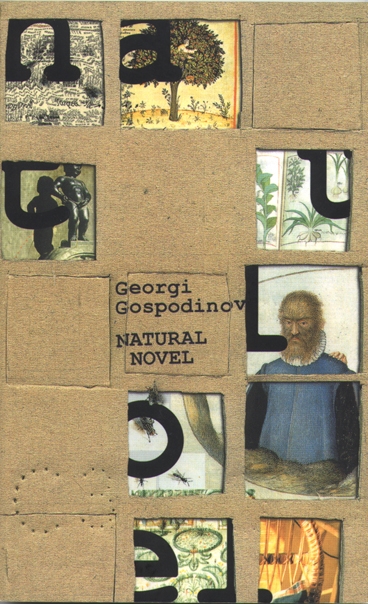
A kunstkamera of thoughts: Georgi Gospodinov's 'Natural Novel'

'Mutual antipathy, just like its opposite, has no need for excuses' (pg. 39, just a quote that I liked).

'Natural Novel', the English edition.

A book without an obvious storyline - good or bad?

Georgi Gospodinov's 'Natural Novel' is one of those books. All we know is that the main character, the narrator himself, has divorced from his wife, now pregnant with another man's child. It seems, the fact of the divorce was the reason why the novel appeared; the cause of the book.

Throughout the book, apart from a few episodes, we don't know where the narrator actually is or what he is doing. It seems, we only get to read his diary, sketches from the writer's journal - while the writer himself is somewhere over there, hiding behind his clever words: making up stories; cracking jokes; chatting with flies in his room; jotting down memories; reflecting his life; imagining his own future (as a weird elderly naturalist of a small town); philosophising; sulking occassionally; collecting information for the natural history of the world's toilets.

The style of telling this novel has been compared to the way a fly sees the world, i.e. fragmented. It is like looking at the same topic (divorce) through many different eyes simultaneously. Or like looking through a caleidoscope.

Undoubtedly, this is a very contemporary way of seeing the world. While reading 'Natural Novel', at times I felt as if I was consuming a multimedia text or a website, jumping from one seemingly unrelated bit of information to another (okay, they do relate on some level eventually, the way everything in this world is related). It certainly is a non-linear way of thinking. 

Gospodinov's 'Natural Novel' was first published in 1999. I remember how around that time my own way of thinking was radically changed and diverted because I became a truly regular user of Google and internet. I remember sitting at a desk at school one day trying to write an essay for the literature class and realising that I could no longer put my thoughts in one line as I used to. The thoughts were jumping at me from all sides as if there was multimedia all around me, both inside my head and outside. I blamed the internet. 
   
At times reading the Gospodinov's book I felt as if reading prose poetry. There is certainly no overload of words, the texts are laconic and polished. At the same time it's quite a musical text. To me, personally, it goes well with electronical music and two films from the same era, 'Trainspotting' (1996) and 'Run Lola Run' (1998) - a concise and dynamic way of telling a story. There are no adjectives or tiring descriptions. Emotion is cut off the text but one can feel it between the lines. Or, as a popular advice for newspaper writers instructs, showing, not telling.  

One may also say that the divorcee man of the 'Natural Novel' is a master of escapism. His mind will wonder around between ideas, dreams, memories, and the more prosaic topics of flies and toilets, avoiding to point itself directly at the actual problem. That is why the book is poetic.

Talking about toilets, the protagonist is quite obsessed with them. For him, toilets are connected to the underground world. Toilet is the place to escape from an unhappy marriage. The protagonist feels, the humble topic of toilets never gets the attention it truly deserves. He might be right.

Georgi Gospodinov is currently one of Bulgaria's cult writers. 'Natural Novel' has been translated into over ten languages (fellow Lithuanians, you can find an edition in your language too).

I cannot say it has been the easiest book to read (should I just blame the hot Bulgarian weathers incompatible with my nordic physique?). However, it was interesting in the way a talk over a drink with someone intelligent is.

If there was a clearer storyline perhaps I would have enjoyed the book more. Well, but we all are now living in modern times, aren't we.    


Review by Agne Drumelyte.

Saturday, 17 August 2013

Sorting out books, that's what we do in August

August is the preferred holiday month for many Bulgarians. Sofia gets unbearably hot, people move to the seaside. Not much point in keeping the libraries open.

Still, the librarians do go to work. They clean dust, polish bookshelves, redecorate reading rooms, sort out and label the books.

That's what we have been doing in August.

Sorting out.

Labelling.

Emptying out reading rooms so that they can be refurbished.


Some more sorting out.

And yet a little bit more.

Cleaning the shelves, German reading room.
Our tutor Valentina, cleaning the Scandinavian literature shelves.

At the Children's Department.

Thursday, 15 August 2013

The importance of wearing a seatbelt. International Youth Day 2013, Sofia


Petar from the Bulgarian National Agency with some goodies to be given away.

August 12 is the International Youth Day, as declared by the United Nations back in 1999. Celebrated annually around the world, the day is meant to raise awareness about the youth issues.

Altough young people form a significant part of the world's population, their problems and achievements are often overlooked. These people are often expected simply to 'be young', in the meantime forgetting that they are the segment of society particularly sensitive to issues like unemployment, poverty, lack of education, drug problems, discrimination. On the other hand, they are the ones contributing heavily as workforce, inventors, artists, scientists, enterpreneurs. The day is meant to highlight both the hardhips and the achievements.

*
In Sofia this year's activities took place next to the famous NDK building. Set up by the Bulgarian National Agency, the event was a mixture of presentations, games and performances. There was one main stage as well as pavillions of various Bulgarian and international youth NGOs: the scouts, the business minded, the environmentally aware, the ones against human trafficking and discrimination, the work camps- and EU projects- related. For those in a more playful mood a labyrinth game was available at mini venues scattered around the park.    
 
An important part of this year's event was run by a cooperation of two Bulgarian & Greek road safety NGOs. Statistics show that road accidents are among the main causes of death among young people. The Greek NGO, Panos Mylonas Road Safety Institute, was initiated in 2005 by a woman whose son was killed in a car accident a year earlier. Among its other missions, the NGO travels internationally with their authentic experience simulators to demonstrate youngsters how important it is to wear seatbelts.       

One of the simulators, a real, normal car with four people in it, slowly rotates as if it was a kebab grilled over a fire. The 'passengers' inside are held only by their seatbelts. Sitting there, upside down, I do realise how easy it would be to break my neck if I was in a real car crash.
     

The kebab-like crash simulator.

Another simulator is a car seat sliding two metres downhill and knocking into a wall. Again, although both the distance and the speed of the 'accident' are low, it wouldn't take much to fall face down on the pavement if the seatbelt was not on.

In addition, one could try stumbling around red traffick cones wearing goggles that imitate vision of a drunk person, and to drive a computer game car in order to measure how ecological their driving skills were, thanks to the Bulgarian 'Open Youth'.

*
For more photos from the event, see below.

Carmen, George and Inga, EVS volunteers at the Bulgarian Infinite Opportunities Association.
Daniel from CVS Bulgaria promoting international workcamps.

Milena from SMART Foundation Sofia.
One of the labyrynth stops.

Giving out leaflets, EVS volunteer David from Armenia.
More interns & volunteers: Madlena (Bulgaria), Kasia (Poland), Eneko (Hungary), Maria (Sweden).

Elina from Latvia in the background of animals.

Saturday, 10 August 2013

'Hope for the Little Ones', a Bulgarian orphanage

Fellow EVS Sarah (middle) and Oles (left) spending time with the infants.

It is the second time in my life I get to hold babies. Once again, I am surprised at how solid and strong a body of a six month old is. When he is interested in something all his body shifts towards the point of attention; when he, lying in my lap, starts to move his arms and legs simultaneously, I fear I may not be strong enough to save him from flying off.

Earlier on I read an article claiming how important it was to all newborns to be touched. According to the text, babies who were not touched grew and developed slower than those who got regular contact. An American NGO was described, members of which go to hospitals on their free time to touch and massage abandoned babies.

Now, spending time with the infants at the 'Hope for the Little Ones' orphanage in Sofia, I indeed notice how much they want to be held and played with. Some start to cry as soon as we put them back to the buggies or disappear out of their sight.  

The youngest one, two month old Maria, has got a hypnotising gaze. She barely makes any sound but with her stare alone makes me freeze next to her bed. She looks fragile, otherworldly; looking at her, I think that people who have just arrived to this world and people about to depart share something in common: a very powerful gaze. Without doing anything extra they can get all the attention; they radiate the most intense nonverbal communication.

There are currently seven infants at the 'Hope for the Little Ones' house. Most of them were abandoned by their parents or taken away by social workers. Mother of one of the girls comes to visit every now and again; another boy is about to be adopted. Quite a few come from Roma families.

The house is for infants of up to three years old. They can stay at the house for up to a year. According to Bulgarian law, foreigners can adopt only those children who have been refused by at least three Bulgarian families.

The numbers of infants at the 'Hope for the Little Ones' are deliberately kept low - this way it is ensured the environment is as homely as possible, rather than that of an institution. Half of the funding comes from the government, the other half from private donations.

There are some full time staff working, as well as incoming volunteers. There can never be too much attention (or touch), so volunteers are welcome to visit, as well as are certain donations (a list of things needed usually is announced at the foundation's website). We brought some books donated by Sofia City Library.

I was expecting a gloomier place when I was coming to visit; in return I discovered a cosy two-storeyed house with a small garden surrounded by trees. There are lots of toys; the pastel green interior is that of a children's room. If all goes well, the foundation is going to open a second orphanage, also in Sofia, in September 2013. The current house has been open since 2010.

Although no institution can be a replacement of one's real family, at least these kids can spend part of their infantry in a safe oasis - for up to a year.  


With Dani (left), the director of the orphanage, in one of the children's rooms.
 
A visit from a doctor: check up, vaccinations, gymnastics.


Monday, 5 August 2013

Bulgarian National Radio: the 78-year-old mammoth with a contemporary twist

First of all, let me tell you that the Bulgarian National Radio has got its own chapel. I found this interesting and unusual:

An Orthodox chapel within the premises of the BNR.

We went to visit the Bulgarian National Radio on one of our networking days. The government-funded media giant has got four major radio channels (national, international), as well as eight regional ones across Bulgaria.

Around 1480 people are currently employed by the BNR - most of them at one of the two headquarter buildings in Sofia, others as regional correspondents. (To put the figures into context, there are around 7.3 million people currently living in Bulgaria, so the BNR staff would account for a 0.02 percent of the population).     

The two national channels are Horizont and Hristo Botev. The first one specialises in news, comments, interviews; between the spoken parts it plays contemporary popular music. Horizont is the most popular radio in Bulgaria, and is often considered the least biased.

Radio Hristo Botev, named after a famous poet and revolutionary, is a high brow cultural channel. On the menu are classical music programmes, concerts, radio theatre plays, cultural news.

The Bulgarian National Radio since its very beginnings has been a promoter of cultural activities in Bulgaria. It has got a record studio that has been helping the less commercially-successful musicians (classical, jazz, folk) to publish their work, a radio theatre, a children's choir, a symphony orchestra, even a big band. The BNR's legendary first director Sirak Skitnink (an 'Orphan Wanderer', real name Panaiot Todorov Hristov, 1883-1943) was a poet and painter himself.    

To give the 78-year-old BNR a modern twist, an innovative internet radio channel Binar was started in 2012 (my colleague Sarah did a post about Binar's one-year birthday party earlier in July). The music Binar plays is contemporary, both popular one and one drifting towards indie. Binar is a bit more than traditional radio as it also plays videos (of interviews in the studio; music clips) on its website.      
    
Finally, the BNR's fourth major channel is the international Radio Bulgaria. This one is aimed at promoting Bulgarian culture around the world and informing about happenings in Bulgaria. As one would expect from an international channel, Radio Bulgaria has got information in eleven languages. Similarly to Binar, the latter channel is internet-based and has got multimedia (images, sounds, videos) on its website.

Among the regional channels, Radio Sofia informs about what is happening in & around the Bulgarian capital; the other cities covered by regional radio channels include Plovdiv, Varna, Bourgas, Stara Zagora, among others.    

At the BNR's radio theatre studio.


The foyer of the BNR building in Sofia.
Mocking a radio show at Binar's studio.
A decree from 1935 announcing the start of Bulgarian National Radio. A radio station initiated by a group of enthusiasts several years earlier was nationalised by Tsar Boris III.

Sunday, 4 August 2013

On-arrival, Albena: the famous EVS training


Dancing an improvised version of horo with a local Roma lady, Albena. 

All EVS volunteers have to undergo training. On 19-24 July we had our 'on-arrival' at the Black Sea resort of Albena, organised by the Bulgarian national agency. There have been nearly sixty trainees in total - EVS volunteers from projects all over Bulgaria - some of them 'on-arrival' like us, others 'mid-term'. 

Four trainers were giving us workshops, supported by several other people from the national agency. 

The training, of course, is not just about partying. A typical day included a couple of three-hour sessions, separated by a two-hour lunch break - the latter typically spent at the beach. 

I was not the only one thinking the sessions were fun but intense. We did: ice-breaking games in order to get to know each others, our projects & countries of origin; psychology workshops (personality types, negotiations, conflict management); classes about practicalities of doing an EVS (volunteerism, AXA insurance); plus creative tasks such as designing posters, shooting short films & running for quests all over Albena. 

We were given an in-depth presentation about Bulgaria and a language lesson, afterwards taken to a traditional restaurant to sample some more of the local cuisine and to watch folk dancing & pre-Christianity style fire shows while eating.

Most of our training sessions were animated by quick exercise sets (yes, you have read it right) in order to awaken our happily exhausted bodies and reset our brains. Even if at times I felt as if I was back at the kindergarden now I think that it was actually quite an effective way to make us learn.

All in all, it has been a good time for most of us, both information- and networking-wise, as well as a chance to uncover yet another Bulgarian destination. 

Thanks to Marionela, Nora, Svet and Atanas, our trainers, who have put some additional knowledge into our heads & for their innovative approach; and to everyone present for making it a worthwile experience. 

I am not going to go into details about the free time we had between & after the sessions but one of my colleagues claims he has made 'friends for the lifetime'. I can add, the new skills and contacts are likely to last beyond our EVS projects.