Sofia City Library, or 'Stolichna Biblioteka', is the main public library of the Bulgarian capital. It is also a hosting organisation for the EVS (European Voluntary Service) volunteers. This blog is a shared diary of the volunteers' project activities.
Bulgarian poet and revolutionary Hristo Botev (1848-1876), approximately one year before his death. Image (c) Wikimedia Commons.
Now, what to write about this poet? His authority in literature - and history - is almost universally unquestioned by the Bulgarians. He is the subject of many studies, books and artworks. He has been so scrutinised that I would probably be unable to say anything exhaustive or new about him.
The person in question is the legendary Hristo Botev. He died when he was 28 years old, leaving behind only 20 poems, plus some opinion pieces and letters - but the short, intense lifespan and the strength of his writings were enough to prove that he was exceptional in Bulgaria, both as a poet and as a political leader.
Today perhaps every Bulgarian city and town has a street named after Botev (along with those named after Vasil Levski, Stefan Karadzha and other revolutionaries). At noon on 2 June every year everything stops and loud sirens commemorate for about a minute the death of Botev back in 1876, during the fight against the Ottomans in Vratsa mountains. He is that important.
As a 19th century author, Botev is a romanticist. His poems are dramatic, expressive, visual, philosophical - all at the same time. Popular topics include homeland; death; a beloved girl; mother, father & other members of the family; freedom fighters (e.g. there are two poems about the death of Vasil Levski and Hadzhi Dimitar); patriotism; solidarity; the struggle for independence. A couple of poems (Patriot and In The Tavern) are sarcastic, questioning the morals of certain people.
Many Bulgarians will volunteer to inform you that a verse by Botev is engraved in gold at the Sorbonne in Paris among other verses by the world's greatest poets:
“The moon comes out and day grows dim, on heaven’s vault the stars now throng, the forest rustles, quiet stirs the wind, the mountains sing song of fighters.”
(from Hadzhi Dimitar, 1873)
It should not take you more than half of a day to get acquainted with Botev's poems. If you are at least a little interested in Bulgaria & its history, reading them is a must. You can easily find the texts of all 20 poems on the internet, for example, here.
Scars. Poems by Blaga Dimitrova. Ivy Press Princeton, 2002.
Yet another Bulgarian poetry anthology by Ivy Press Princeton is Blaga Dimitrova's 'Scars'. To me personally Dimitrova's poetry book was more appealing than the previously reviewed selection of Konstantin Pavlov.
Like Pavlov, during the soviet era Dimitrova was known as a dissident poet (and a socially active person: in 1992 she became the first democratically elected Vice President of Bulgaria). Her poetic style, however, is quite different from Pavlov's.
Lighter in style (although no less serious), more precise, more elegant, very articulate. Dimitrova does not talk abstract; instead she reflects on things around her, including her own body parts (hair, tongue, throat), and uses them to make philosophical statements about life, love, and the universe. Although Dimitrova is very aware of her immediate environment she is not mundane because she puts things into perspective. She notices details but does not get overwhelmed by them.
In this book, Dimitrova never gets drowned in emotion, even though some of the experiences she is talking about are among the strongest (loss; dementia of a loved one; near death experiences). The poet remains quite rational; all her emotions get distilled and rearranged into logical compositions before they land on paper as poems.
Perhaps it is also a better quality translation than the previously reviewed Pavlov's book (the translator of the both is the same: Ludmilla G. Popova-Wightman). The translator was a friend of the poet, and, possibly, because of this reason was able to understand the author's inner workings better.
'Scars' consist of five sections: Ars Poetica (poems about writing poetry); Lullaby for My Mother (mainly about the poet's mother ill with Alzheimer's; although the father is occassionally mentioned too); Love (self-explanatory); Delirium in Green (the author's near death experiences at the hospital); and Sentence (heavyish reflections on the life that has already passed).
'Scars': the poet does not like to bleed in public. She heals her wounds in privacy and all that is presented to us are her remaining scars. Here scars = poems.
*
I create you out of sadness absence need, out of
loneliness emptiness nothingness - to come to me. And unnaturally, you
arrive, as you think, of your own free will, not doubting it for a moment.
La verdad es que me sorprendió mucho encontrarme este libro en la Sala Escandinava de la Biblioteca de Sofía. No por la temática, claro. Un título como Literatura finlandesa de Kai Laitinen es justo lo que una espera encontrar en una sala dedicada a la literatura y el idioma de los países del norte de Europa. Hasta ahí correcto. Lo que no me imaginaba es que me iba a encontrar un libro en español, y como ya sabéis que me puede la curiosidad, pues me lo traje a casa.
No sé vosotros, pero yo sé más bien poco de literatura finlandesa. De hecho, aunque Arto Paasilinna es uno de mis autores favoritos, creo que es el único de esta nacionalidad que he leído en mi vida. Tengo en casa, pendiente de lectura, Purga de Sofi Oksanen, autora finlandesa ganadora de numerosos premios europeos, pero hasta ahí llega mi conocimiento que, como podéis comprobar, es bastante limitado.
Animada por las pequeñas dimensiones del libro (formato pequeño y apenas 160 páginas) lo adopté durante un tiempo para echarle un vistazo y aprender algo nuevo, que nunca está de más. Suponía (y no me equivocaba) que el libro me iba a dar una visión bastante somera de la historia literaria de un país que, reconozcamoslo, es casi desconocido en España.
Desde las primeras canciones populares hasta los autores contemporáneos, de la ilustración a la desgarradora novela de posguerra, del sueco y el latín como lenguas predominantes en la literatura finlandesa hasta el finés como un idioma literario. Y, en medio de todo, El Kalevala, la gran epopeya finlandesa, la gesta inolvidable de un pueblo, una compilación de repertorios populares realizada por Elias Lönnrot en el siglo XIX y que se ha convertido en el símbolo de un país, de una cultura y una tradición.
Sin embargo, en más de una ocasión, el libro se convierte en una mera lista de autores, aportando muy poco a la historia de la literatura propiamente dicha. Sí, es demasiado corto, ya me imaginaba que no iba a profundizar demasiado, pero en algunos casos me he quedado con ganas de saber más de la evolución real de su literatura que un nombre tras otro de autores...
Su autor, Kai Laitinen, es catedrático emérito de Literatura Finlandesa en la Universidad de Helsinki, por lo que me imagino que algo sabe del tema. Además, se trata de una figura muy influyente en las letras finlandesas desde los años cincuenta. Ha trabajado como crítico y director en diversas revistas literarias, además de ser jurado en varios premios literarios por toda Europa.
Como primera toma de contacto con la historia de la literatura finlandesa es correcto, aunque ya os digo que en ocasiones se parece más a una lista de la compra de autores que a un ensayo de historia literaria. Es sí, su función la cumple a la perfección, porque lo cierto es que ahora me han entrado ganas de conocer más sobre la peculiar historia de este país, leer más a Arto Paasilinna, empezar 'Purga' de Oksanen de una vez, y sí, conocer a autores de los que nunca había oído hablar y que tienen nombres imposibles de pronunciar. Si a vosotros también os ha entrado curiosidad, lo tenéis disponible en la Sala escandinava de la Biblioteca de Sofía en la plaza Slaveikov. Allí estará, esperándote...
Jos mum tuttuni tulisi
Ennen nähtyni näkyisi.
Sillen suuta suikkajaisin
Olis suu suden veressä.
Sillen kättä käppäjäisin
Jospa kärmä kämmen päässä!.
(Si mi amigo viniera/ si mi amado se dejara ver. / Le besaría en la boca/ aunque estuviera manchada por la sangre de un lobo./ Le estrecharía la mano/ aunque contuviera una serpiente.)
Let me tell you about yet another Bulgarian writer, Konstantin Pavlov.
Capriccio for Goya. Selected Poems 1955-95, the bilingual edition. Translated to English by Ludmilla G.Popova-Wightman.
Chances are, you already know him as Pavlov is said to be among the Bulgarian classics of the 20th century. To me, however, Capriccio for Goya. Selected Poems 1955-95 was the first Pavlov's book I have read.
There is an important thing to remember while reading these poems: Pavlov happened to live most of his productive years under the communist regime. Being an artist of any kind during the communism meant facing state censorship. All the artwork had to be politically correct; socialist realism style was the only allowed.
The imposition of socialist realism meant all the artwork had to be simple, happy, of an uplifting mood, expressing proletarian values and glorifying the socialism. One was not supposed to show any doubts about the meaning of life or about the virtues of the socialist system. Those who did were censored and silenced.
As a result, two phenomena emerged in soviet literature: Aesopic language and samizdat. The first one meant using ambiguous, allegorical phrasing so that the piece passes the censorship but the readers are still able to decipher its hidden antisocialist messages. The second one stood for underground publishing, sharing and multiplying the banned texts. The samizdat texts were exchanged in private, read at homes when no-one was watching, discreetly discussed in trustworthy friends' kitchens, and often rewritten - by hand or a typewriter - so that more people can get 'enlightened'.
Konstantin Pavlov was one of those socialist poets who did not want to write texts glorifying the system. Although he did manage to get his first two poetry books published, starting with the third one he fell into disgrace with the socialist critics and was condemned to long years of samizdat and Aesopic language. He was no longer officially recognised as a poet; his texts were regularly refused by literary magazines and publishing houses. Despite his popularity in the underground and abroad, Pavlov had not been acknowledged as one of the Bulgarian classics up until very recently. Some fans claim, the severe stroke Pavlov had experienced in the early 2000s was a consequence of the years of rejection.
*
I will have to be honest: Pavlov's Capriccio for Goya is not one of my favourite poetry books. Too much suffocation and helplessness can be felt here; too much of a small town mentality. I have missed sharper irony, wilder thoughts, higher flights. It is way too easy to state:
I wake up And what horror - I find that I'm alive ('Endless Poem', Second Fragment, page 123)
I would prefer a curvier virage before one declares his/her desire to die - but, remember, we need to put things into perspective: Pavlov lived under the socialist system. One cannot, for example, expect truly untamed virages from a socio-economically dependent teenager (however poetic) who lives with possessive parents.
Likewise, in another poem, 'The Insight of a Sparrow' (pg.169), Pavlov simply declares 'us' the small socialist sparrows who breed the eggs of the cuckoo of Stalinism. In 'Shoe, Loyal Like a Dog' (pg. 231-33) a morning turns out duller than last evening when the poet, in his real life or allegorically, lost one of his shoes.
The whole book feels like poetry in which the author never really takes off to another dimension, never really leaves his claustrophobic, realistic environment. Although he keeps disapproving of the system he is in, he never actually gets out of it.
*
Poems are not the easiest literary genre to translate. Perhaps because of this reason the said Capriccio for Goya edition is bilingual: on the right side pages you have the English translations; on the left side the same (original) poems in Bulgarian.
'Capriccio for Goya. Selected poems 1955-95' contains only a fragment of all Pavlov's work. Selecting certain poems over others is a subjective process and this book surely does not represent all Pavlov's talents.
I would recommend this book as a historical document - one that illustrates a mindset of a person living under the socialism - rather than a source of good poetry but you are welcome to disagree.
'Mutual antipathy, just like its opposite, has no need for excuses' (pg. 39, just a quote that I liked).
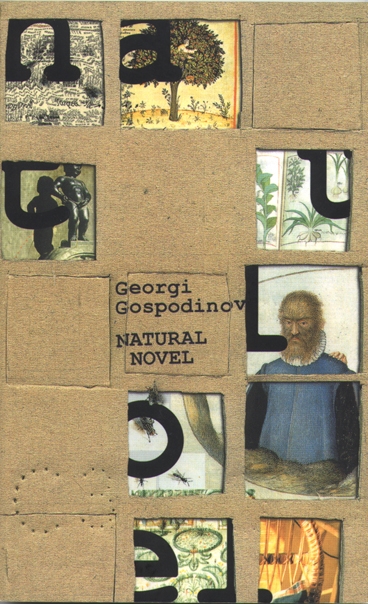
'Natural Novel', the English edition.
A book without an obvious storyline - good or bad?
Georgi Gospodinov's 'Natural Novel' is one of those books. All we know is that the main character, the narrator himself, has divorced from his wife, now pregnant with another man's child. It seems, the fact of the divorce was the reason why the novel appeared; the cause of the book.
Throughout the book, apart from a few episodes, we don't know where the narrator actually is or what he is doing. It seems, we only get to read his diary, sketches from the writer's journal - while the writer himself is somewhere over there, hiding behind his clever words: making up stories; cracking jokes; chatting with flies in his room; jotting down memories; reflecting his life; imagining his own future (as a weird elderly naturalist of a small town); philosophising; sulking occassionally; collecting information for the natural history of the world's toilets.
The style of telling this novel has been compared to the way a fly sees the world, i.e. fragmented. It is like looking at the same topic (divorce) through many different eyes simultaneously. Or like looking through a caleidoscope.
Undoubtedly, this is a very contemporary way of seeing the world. While reading 'Natural Novel', at times I felt as if I was consuming a multimedia text or a website, jumping from one seemingly unrelated bit of information to another (okay, they do relate on some level eventually, the way everything in this world is related). It certainly is a non-linear way of thinking.
Gospodinov's 'Natural Novel' was first published in 1999. I remember how around that time my own way of thinking was radically changed and diverted because I became a truly regular user of Google and internet. I remember sitting at a desk at school one day trying to write an essay for the literature class and realising that I could no longer put my thoughts in one line as I used to. The thoughts were jumping at me from all sides as if there was multimedia all around me, both inside my head and outside. I blamed the internet.
At times reading the Gospodinov's book I felt as if reading prose poetry. There is certainly no overload of words, the texts are laconic and polished. At the same time it's quite a musical text. To me, personally, it goes well with electronical music and two films from the same era, 'Trainspotting' (1996) and 'Run Lola Run' (1998) - a concise and dynamic way of telling a story. There are no adjectives or tiring descriptions. Emotion is cut off the text but one can feel it between the lines. Or, as a popular advice for newspaper writers instructs, showing, not telling.
One may also say that the divorcee man of the 'Natural Novel' is a master of escapism. His mind will wonder around between ideas, dreams, memories, and the more prosaic topics of flies and toilets, avoiding to point itself directly at the actual problem. That is why the book is poetic.
Talking about toilets, the protagonist is quite obsessed with them. For him, toilets are connected to the underground world. Toilet is the place to escape from an unhappy marriage. The protagonist feels, the humble topic of toilets never gets the attention it truly deserves. He might be right.
Georgi Gospodinov is currently one of Bulgaria's cult writers. 'Natural Novel' has been translated into over ten languages (fellow Lithuanians, you can find an edition in your language too).
I cannot say it has been the easiest book to read (should I just blame the hot Bulgarian weathers incompatible with my nordic physique?). However, it was interesting in the way a talk over a drink with someone intelligent is.
If there was a clearer storyline perhaps I would have enjoyed the book more. Well, but we all are now living in modern times, aren't we.
"zift (zĭft) n. 1.black mineral pitch, bitumen, asphalt; used as bonding material for road surfacing and, in the past, as streetwise chewing gum. 2.Slang. shit. [Turkish, from Arabic]"
In 1943, at the age of eighteen, he goes to prison to serve a sentence for a murder he didn't commit. Twenty years later he is released, only to discover that the world as he knew it doesn't exist anymore. It's now 1963, one of the gloomiest times of communist Bulgaria. The whole political system has changed.
Upon leaving the prison, Moth has a vision: to settle in a tropical island and swing in a hammock for the rest of his life. Instead, he finds himself in a reality more suffocating than any prison: that of a totalitarian state.
Right outside the door a bulky soviet Pobeda car (the name means 'victory' in English) awaits; it takes him to Slug, Moth's former gang mate, and the actual killer - now a police officer. Slug has in his interest that (1) the truth about the murder is never revealed; (2) Moth tells him where a precious diamond is. Moreover, Slug sleeps with Moth's beloved Ada, a.k.a. the Mantis - although Moth has yet to find this out, the hard way.
Slug poisons Moth and declares he would be dead by the next morning. Although Moth manages to escape, he is doomed. With Slug plus companions on his heels, body & willpower declining, Moth runs through the night streets of Sofia. He is lonely, injured, being chased; the city of his youth no longer shelters. He can trust no-one, and his lover now plots with his persecutor.
Moth indeed dies the next morning: in a cemetery, at a gravediggers' office, with a pair of misshapen work boots under his head, being looked-after by the deputy-chief gravedigger - perhaps the only genuinely caring person in the whole story. He dies chewing on zift, his default choice of chew (although this last time the reason why Moth wants to munch on zift is a bit different).
Symbolically, the novel takes place during one of the longest nights of the year, that of the 21st of December. Although it does have some comic elements, the novel is gloomy, just like life back in the communist times. Through the story of Moth, we learn about the realities of a totalitarian state.
*
After reading the novel, I no longer feel the same as I walk through my current neighbourhood in Sofia. Fragments of the city's recent past seem to be everywhere, and I keep thinking about the events described. Although Zift is a fiction book, it is based on real facts - it is a historical novel. It reminds me of another similarly gloomy book, Vilnius Poker by Ricardas Gavelis, about the soviet times in my home city Vilnius.
I find Zift a valuable book in a way that it tells about the realities of the communist past. A former involuntary soviet* myself, I often notice that certain people in Western Europe find things connected with Eastern Europe's socialist past exotic, adorable. Typically, those are not the most historically aware leftists who easily get hooked on symbolics such as USSR flags & hammer and sickle t-shirts.
Therefore, I believe, historical novels like Zift are highly needed. More than 20 years have gone now since the end of the Eastern Bloc but there still is a shortage of information about what was happening in that part of the world for a half of the 20th century. We need historical fiction so that the average, lay people become more aware - not just the academics.
*
In 2008 a namesake film was released, with the script written by the novel's author Vladislav Todorov. Told in a tough, laconic manner, it immediatelly became cult in Bulgaria, and won numerous awards in local film festivals.
The film is entirely black-and-white, thus giving a first impression (to me, at least) of a TV documentary from the 1960s. I have to say I have not yet had the chance to watch the film, apart from a few random episodes on YouTube.
Below is the trailer. If we excuse the earsplitting soundtrack, Zift does indeed look like a promising movie. Or exotic and/or comical - depends on what you are looking for.
Zift, the film trailer (2008). Directed by Javor Gardev.
A copy of Vladislav Todorov's Zift (in English) can be found at the library.
* from Lithuania. During the early communist times part of my family - as well as thousands of other Lithuanians, Latvians and Estonians - were banished to Siberia and labour camps for not being 'good' socialist citizens. A historic novel Between Shades of Gray by Ruta Sepetys gives an insight into such deportations.
I have to confess that I really love Ray Bradbury. Yes, is one of my favorite authors so maybe love blinds me while I writing this book review. If you like this author, you'll love this book. If you like to write yourself, you'll love this book, too. Even if you don't write so much or you never read Bradbury, you'll like this book.
And the reason is so simple. Ray Bradbury puts his passion in his writing. He loves ghosts, he loves circuses, he loves dinosaurs, he loves Mars, he loves to write. And, of course, he loves to write about the things he loves.
Makes sense, but it's not as common as it seems. Not every author prefers to follow their own path, as it's for this reason that this reading is so valuable. In eleven essays, Bradbury told us about the pleasures of writing. His enthusiasm has no limits, he lives for writing, for enjoy, for celebrate, and all about writing.
He gives us one of the most important advices I've ever read in my life: enjoy your creation. Enjoy, don't think, write. Write about the things you like and everything would be good.
If you do, I think you might easily find a new definition for work.
And the word is LOVE.
In these essays, Ray Bradbury write about his passion for the writing, but also about the power of the inner memories, his likes and dislikes and how he become a writer. Of course, we can read a lot about his most famous works like Dandelion Wine, Fahrenheit 451, The Martian Chronicles and even the play script he wrote for John Houston's Moby Dick.
All during my early twenties I had the following schedule. On Monday morning I wrote the first draft of a new story. On Tuesday I did a second draft. On Wednesday a third. On Thursday a fourth. On Friday a fifth. And on Saturday at noon I mailed out the sixth and final draft to New York. Sunday? I thought about all the wild ideas scrambling for my attention, waiting under the attic lid, confident at last that, because of 'The lake', I would soon let them out.
If you ever thought about creative writing I encourage you to read this book. It's not a proper manual about writing, its better. If you need a bit push to sit down yourself and start to write (maybe for the Camp Nanowrimo? ;p) read it. His enthusiasm is contagious and when you finish you'll be burning in desire to write. A novel, a short story, a script, even a list of things to do. Whatever, but you'll be writing with hope and passion.
I promise you.
Remember you can read this book from the American Corner of the Sofia City Library. You only have to visit us and will be very glad of recommend you a lot of more books about your favorite topic. And, of course, I will recommend you ALL the books of Ray Bradbury. Because I love him, you know...