Sunday, 14 July 2013

From Portugal to Tibet. A walk (out) of love.

I have been observing Marc hanging out in Slaveykov Square opposite our library for a few weeks. He is usually there around lunchtime; sometimes spending time on his own, at other times talking to people; radiating an aura of a long-term traveller; someone coming from a different environment. One day I had to stop and talk to him. 

Marc, the Luxembourgish pilgrim in Sofia.

Marc is currently on his way from Portugal to Tibet. He makes all the journey solely by walking, as promised to himself two years ago. He set off from Algarve, Portugal, in April last year (2012), and expects to reach Tibet at the end of next year (2014) - if all goes without interruptions. He is, however, not in a rush, as life on the road is his way of life now.

*
Up until his late 40s Marc was living a life of a normal Luxembourgish professional, working at a medical laboratory researching into newborns' thyroid gland functions. He liked the job but not the lifestyle, and certain colleagues, putting questions like what brand of car to buy next as central ones to their lives, were driving him mad: "I think I was never made for a normal life".

He had been dreaming about long journeys since childhood; the work enabled him to travel only a fortnight per year. In 2004, taking off all the unused holidays that he had accummulated during the years, Marc went to Tibet & Nepal. There, he made the "now or never" decision to change his life.

Sold his home, bought a motorbike, travelled the world for the next seven years.

In Morocco he fell in love with a local Arab girl. Her health was declining, she needed a surgery. Marc sold his motorbike to pay for the treatment and made a promise: if the girl recovers he will make a pilgrimage to Tibet. 

He has been walking for 15 months now. Although she has recovered, chances are, he says, he will never see the girl again.   

*
Although not a religious person himself, Marc says he prefers doing the pilgrimage the traditional way, which means living solely off other people's generosity and donations.

Sometimes he has to go for days on end with empty pockets but still prefers his current way of life to the previous one because "a miracle can happen at any time".  

"In my previous life I had everything that I needed but I was never happy because I couldn't do what I wanted. Now my life is much harder but I really enjoy it, even in a really bad situation".

His current odyssey was partially inspired by a Spanish guy Marc met during the motorbike trips. The only survivor of a ship accident, the Spaniard was walking the world's pilgrimage sites for nine years.  

*
In order to give his long walk more sense, Marc is trying to raise money for a few charities.

Humedica.org, according to him, is similar to the international 'Doctors Without Borders' but "smaller and more serious". The one called Earthlink works on removing children labour from manufactories in India and China.

The third one, Braille Without Borders, was established by a blind Dutch girl who travelled to Tibet and created the Tibetan version of the Braille script. The charity tries to empower blind people in developing countries.

Besides the three mentioned above, Marc is fundraising for a few smaller Himalayan foundations - the full list can be seen on his personal website 'MyJourneyToTibet' - as well as the PayPal linkto give a donation to himself.

He claims he might also write a study of people's hospitality in different cultures. 

*
He doesn't seem to have any insecurities about people in the countries he is about to cross, even if some of those countries currently are not among the most socially stable. Marc's main worries at the moment are about getting the necessary visas.

The Pakistani visa has already been refused so he needs to find an alternative route for that part of the journey. The border between India and Nepal is currently closed - no one can cross it. The Tibetan visa is not the easiest to get either: sometimes the entrance is banned altogether, at other times it may only be possible to enter Tibet as part of an organised group tour.

He has been stuck in Bulgaria for about a month now, waiting for a bank card to arrive. Although he regrets not being able to progress with the journey, he nevertheless enjoys meeting new people. On 26 June he even became a star of the local TV programme BNT Taxi.

*
Next, the walk should continue through Greece, Turkey, Iran.

The arrival to Tibet will probably be completed with a visit to the holy Mount Kailash, and then six months' work at a Tibetan community in India. "I have no plan at all to go back to Luxembourg. I think I will continue my adventures, or the crazy life, however people call it".

Marc thinks it should be compulsory for everyone to do a year of pilgrimage as part of their education. For example, a year of university could be replaced with a year of such travelling. "That would be a nice, important experience for life. It makes one open-minded, you stop judging other people, get more tolerant". 

The journey can be followed here:http://myjourneytotibet.com/.

The Facebook page of the journey: https://www.facebook.com/tibet.tenzin

Tuesday, 9 July 2013

Bulgaria and Russia: a special relationship

While spending time with Bulgarian and Russian delegates at this year's International Forum I cannot help but think about the special relation between the two countries.

 
Obviously, both countries are predominantly Slavic, and both share the recent socialist past, but their connections run deeper than that. 

Many Bulgarians will proudly tell you that they gave the Cyrillic alphabet as well as the first Slavic Christian texts to the big cousin, via the Saint brothers Cyril and Methodius.
 
Monks Cyril and Methodius displaying their masterpiece. Source: Wikipedia.

A thousand years later, Russia - by then one of the world's largest empires - liberated Bulgaria from a nearly 500-years' Ottoman yoke*. This happened during the Russo-Turkish War of 1877-78.

Surely, the newly-liberated knew how to appreciate this. In many Bulgarian towns multiple monuments in order to honour the Russian army, its generals, and the emperor Alexander II were built.  

Alexander II. Source: Alexanderpalace.org.

In Sofia alone, there is the Russian Church, the Alexander Nevsky Cathedral, the Russian Monument (Ruski Pametnik), and the Monument to the Tzar Liberator high on a horse   - all initiated at the turn of the 20th century.

Even if nowadays some Bulgarians say they have been deeply disappointed by the recent experiences as part of the Communist Block, the monuments in their cities and some historic sentiments still remain.

* the dramatic word 'yoke' is a favoured phrase by many Bulgarians to describe the times when Bulgaria was part of the Ottoman Empire. The phrase potentially originates from Ivan Vazov's novel Under the Yoke - one of the great classics of Bulgarian literature. Bulgarian children spend long months at school reading and analysing the novel.        

It's a yoke.

Monday, 8 July 2013

The International Forum: fortifying the positions of the Russian language and culture

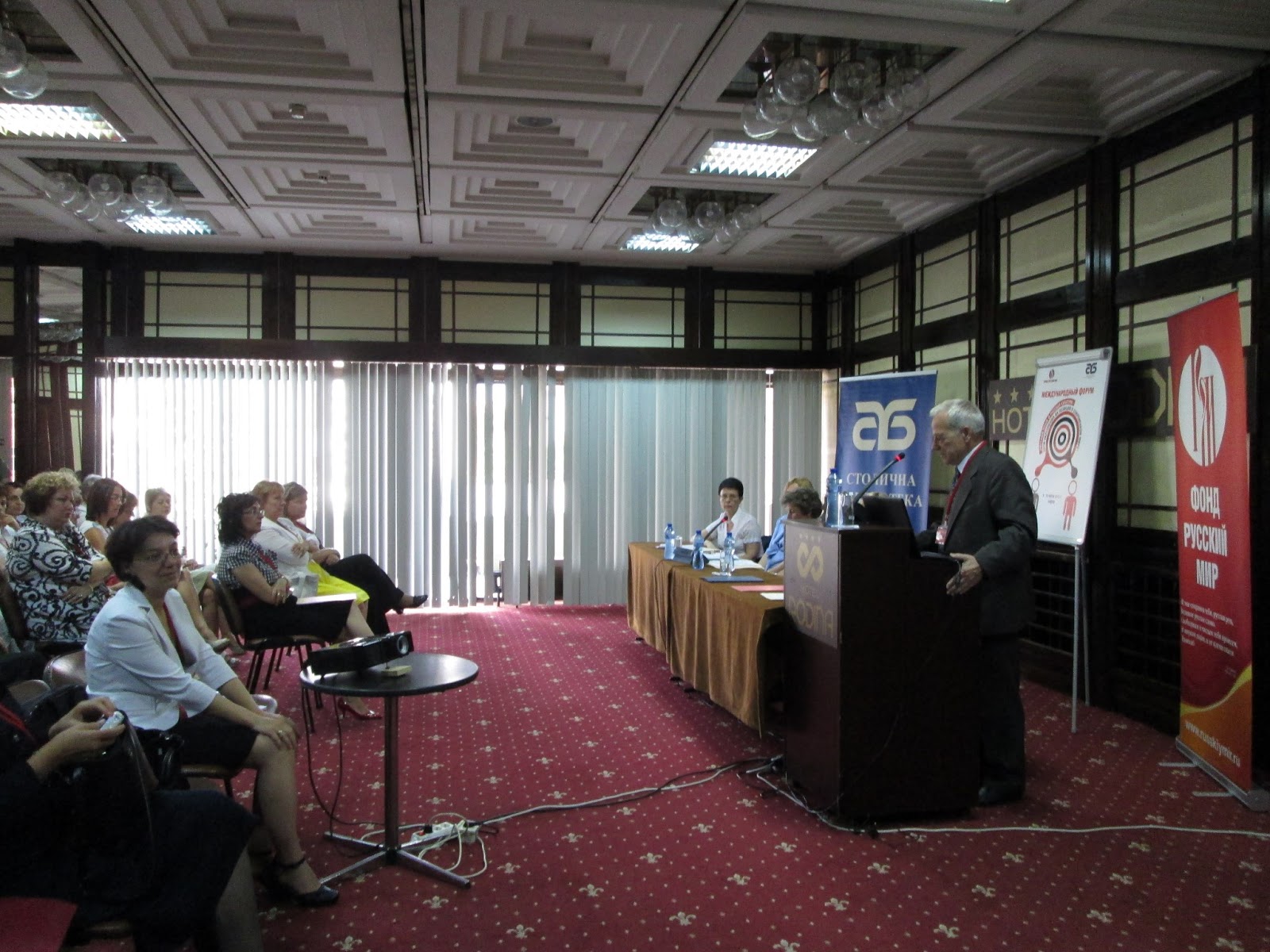
The Russkiy Mir Foundation is a Russian governmental organisation dedicated to promoting the Russian language and culture around the world. The Foundation has working Russian Centres in multiple countries, including one at the Sofia City Library.


On 6-10 July 2013 the library's Russian Centre runs a conference called the International Forum. Aimed at Russian-speaking teachers and university lecturers, the conference includes lecture days as well as visits to Bulgaria's tourist attractions.

The opening of the conference.

This year's conference has got around 130 participants, mostly from Bulgaria and Russia, although a few people from other countries, e.g. Kazachstan, Estonia, Turkey, are also present. We helped the library, our current employer, to set up the opening of the conference and, along with the guests, visited a few tourist attractions.


Friday, 5 July 2013

Five hours on the train, worth it: Going to Plovdiv

The Roman theatre of Plovdiv, now nearly two thousand years old, and still hosting performances.
 
Doing an EVS often includes a fair share of travelling. We have joined fellow volunteers from the Sofian SMART Foundation for a day trip to Plovdiv.


Plovdiv, Bulgaria's second largest city and one of the most culturally important, surely cannot be all seen in one day but, as it was the first visit for most of us, it has been a nice introduction.

There is a big size difference between Bulgaria's capital Sofia and the next major cities, the former being at least 3.5 times larger in population than Plovdiv & Varna, and six times larger than Bourgas.

As one can expect, Plovdiv has got a more relaxed vibe than the busy capital, and feels green and refined like a typical university town. Rumours say, it also has got a nightlife of a typical university town, although this time we were unable to check it.

The city has got a significant population of cats, looked after by the locals collectively.

Plovdiv is among the oldest cities of Europe, being continuously inhabited since at least 4000 BC. Originally established by the Thracians, it later became known as the Roman city of Philipopolis. There are some remaining ruins from both Thracian and Roman eras in Plovdiv, as well as treasures in the city's Arhaeological Museum.   

Finally, Plovdiv's old town is also a good place to go and appreciate the so-called Bulgarian National Revival architeture of the nineteenth century, see a couple of my photos below.  


Thursday, 4 July 2013

'Zen in the Art of Writing', Ray Bradbury gives us a masterclass

A great way to start the day

I have to confess that I really love Ray Bradbury. Yes, is one of my favorite authors so maybe love blinds me while I writing this book review. If you like this author, you'll love this book. If you like to write yourself, you'll love this book, too. Even if you don't write so much or you never read Bradbury, you'll like this book.

And the reason is so simple. Ray Bradbury puts his passion in his writing. He loves ghosts, he loves circuses, he loves dinosaurs, he loves Mars, he loves to write. And, of course, he loves to write about the things he loves.

Makes sense, but it's not as common as it seems. Not every author prefers to follow their own path, as it's for this reason that this reading is so valuable. In eleven essays, Bradbury told us about the pleasures of writing. His enthusiasm has no limits, he lives for writing, for enjoy, for celebrate, and all about writing.

He gives us one of the most important advices I've ever read in my life: enjoy your creation. Enjoy, don't think, write. Write about the things you like and everything would be good.

If you do, I think you might easily find a new definition for work
And the word is LOVE.

In these essays, Ray Bradbury write about his passion for the writing, but also about the power of the inner memories, his likes and dislikes and how he become a writer. Of course, we can read a lot about his most famous works like Dandelion Wine, Fahrenheit 451, The Martian Chronicles and even the play script he wrote for John Houston's Moby Dick. 

All during my early twenties I had the following schedule. On Monday morning I wrote the first draft of a new story. On Tuesday I did a second draft. On Wednesday a third. On Thursday a fourth. On Friday a fifth. And on Saturday at noon I mailed out the sixth and final draft to New York. Sunday? I thought about all the wild ideas scrambling for my attention, waiting under the attic lid, confident at last that, because of 'The lake', I would soon let them out. 

If you ever thought about creative writing I encourage you to read this book.  It's not a proper manual about writing, its better. If you need a bit push to sit down yourself and start to write (maybe for the Camp Nanowrimo? ;p) read it. His enthusiasm is contagious and when you finish you'll be burning in desire to write. A novel, a short story, a script, even a list of things to do. Whatever, but you'll be writing with hope and passion.

I promise you.

Remember you can read this book from the American Corner of the Sofia City Library. You only have to visit us and will be very glad of recommend you a lot of more books about your favorite topic. And, of course, I will recommend you ALL the books of Ray Bradbury. Because I love him, you know...

Joshua Odell Editions
Collection: Essays on Creativity
ISBN: 9781877741098
176 pages

Wednesday, 3 July 2013

Do you want to write a novel...right now?

Camp NaNoWriMo, where everything is possible. Literally.

Maybe you are this kind of people. You know, the kind who is always planning and talking about write a novel... some day. But now you have the chance of write a novel in a month. In this month.

Really. Trust me.

Is not magic. It's passion. Love. Madness. It's Camp NaNoWriMo

Camp NaNoWriMo is a quest to write a novel in a month's time. That's all. You only have to write, and write more. And then, write a bit more. So easy. Well, maybe it's not so easy but you only have to enter in the website, choose a word goal and start to write. Don't worry about corrections now. In the next month, or maybe in the next year, you can correct all your mistakes, but in this moment you only have to write. Really.

Sit down. Write down.

It's crazy, I know, but there’s so much fun and noveling is like a kind of magic. And you have this magic in your hands right now so don't waste it! Maybe you are afraid. I understand you. It's difficult to start to write but when you decide to do, it's wonderful! Don't miss it!

Of course, I'm enrolled as well in this Camp NaNoWriMo. I set my goal on 20.000 words for this month and for the moment I haven't write any word. Nothing. It's a shame for me, but don't worry. I'll reach my goal for sure. I only have to write, ehem. 

Do you wanna do this crazy thing with me? It would be great! We'll can cry at the same time, you know, and blame everything in our characters, and talk about plots and the essence of the divinity... Just let me know... If you are interested in creative writing, stay tuned! This is the first time that Sofia City Library is hosting the NaNoWriMo adventure and in the beginning of September we are preparing a lot of projects about this so I will very happy to hear about you. Come to our library and ask us! We are ready to encourage you to start the most amazing chance in your life.

And now, it's time to write. Are you ready?


More info | Camp NaNoWriMo

Tuesday, 2 July 2013

Why people do good things?


Bulgarian researcher Hristo Hristov is trying to find out about the reasons and motivations that make people do charity work. The research is part of his PhD thesis at the Bulgarian Academy of Sciences and is likely to grow into something more.

He has been working on this project for a few years now and has been looking for altruistic people from different countries to share their motivations with him. 

You may be an EVS volunteer, a charity worker, staff at an NGO, a philanthropist, or simply someone who every now and again gives a few coins to a poor person in the street. You may be doing your good deeds to the society or to the mother nature. 

You might be one of those people who look after abandoned pets at an animal shelter or helping out at a hospital. If at any point of your life you have tried to reduce the injustice and suffering in this world, Mr Hristov wants to hear your opinions. 

Equally, if you are a scientist in a similar field yourself, you are welcome to contact him for collaboration.

Unfortunately, Mr Hristov does not yet have a website dedicated to his research, but if you send him an email expressing your interest he will email you back with the link to the online questionnaire. Alternatively, you can get the paper version of the form sent to you. The questionnaire is available in nine major European languages. 


Doing the questionnaire with Mr Hristov (right).